

On June 28, 2025, an act implementing the EU European Accessibility Act into Polish regulations entered into force in Poland – and from that moment on, digital accessibility was no longer only a problem for offices. It also covered private companies: online stores, banks, carriers, and digital service providers. The standard referred to in the regulations is WCAG 2.1 at AA level, and the penalty for non-compliance may be up to 10% of the company’s annual turnover. Below we explain who this applies to, what exactly must be fulfilled and who can impose such a penalty.
What is WCAG and why is it no longer just “good practice” in 2026?
WCAG (Web Content Accessibility Guidelines) are international guidelines developed by the W3C consortium, defining principles for designing websites and applications accessible to people with various disabilities—visual, hearing, motor, and cognitive. The guidelines are based on four principles, known as POUR: content in applications and websites should be perceivable, operable, understandable, and technically sound.
For years, this was a topic primarily for the public sector – offices were required, but businesses were allowed. However, from 2025, accessibility will also become a strict legal obligation for businesses, with real financial penalties for ignoring it.
What regulations regulate digital accessibility in Poland?
There are currently two separate acts in Polish law regarding digital accessibility and they cover completely different entities. This distinction is important because it determines what penalties are at stake.
Digital Accessibility Act 2019 – Public Sector
The first, older regulation applies to websites and mobile applications of public entities: offices, schools, universities, and local governments. It requires compliance with WCAG 2.1 AA and the publication of an accessibility declaration. Fines are small – a few thousand złoty for website inaccessibility or for failing to submit a declaration.
The EAA Implementation Act – This is where things get serious
The second act, of April 26, 2024, is the one that actually applies to companies. It implements the European Accessibility Act (2019/882) and entered into force on June 28, 2025. For the first time, the obligation of accessibility covered the private sector on a large scale – and it is in this act that severe penalties are described, more about which later in the article.
Who does the digital accessibility obligation apply to?
The Act covers companies offering products and services deemed essential for the independent functioning of people with disabilities and seniors. Specifically, it covers:
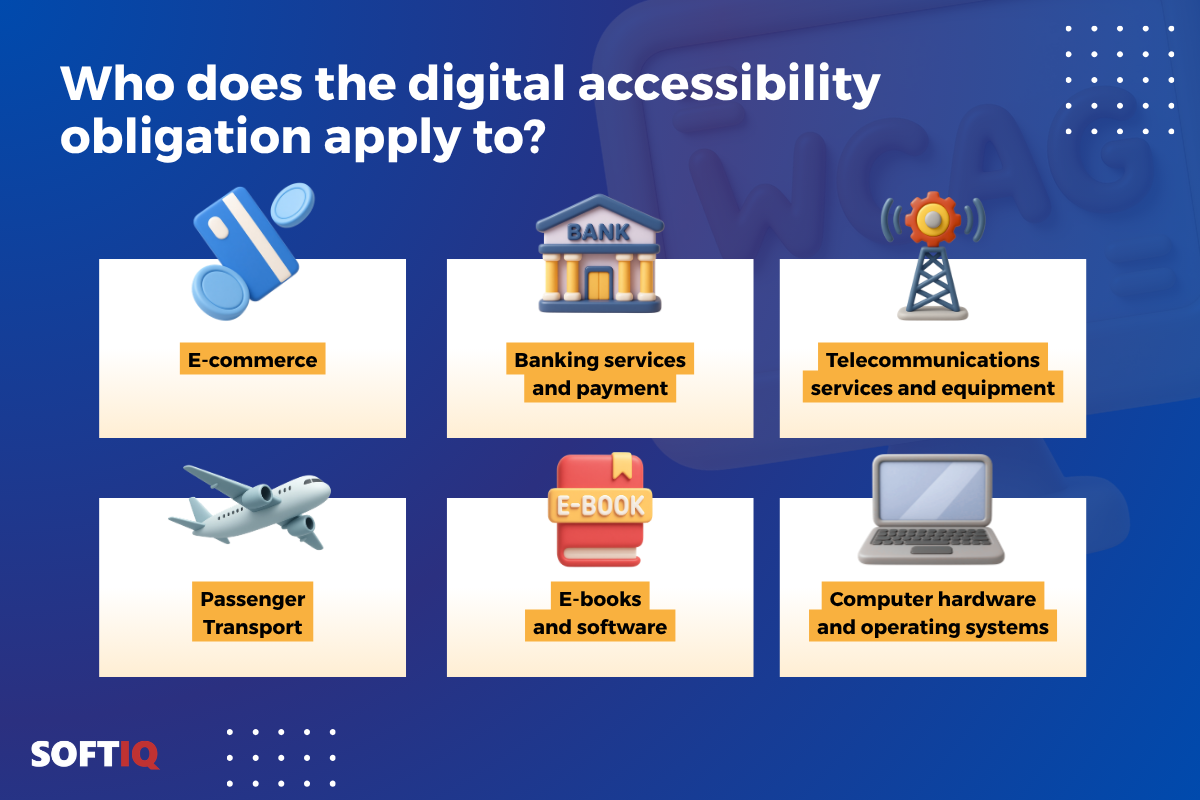
- e-commerce – any form of distance selling, including situations where the purchase begins online and ends in-store (e.g. reservation with payment at the premises)
- banking and payment services for consumers
- telecommunications services and electronic communication equipment
- passenger transport – websites and applications for ticket sales, travel information
- e-books and software for reading them
- computer hardware and operating systems introduced to the market
Who is exempt from the obligation?
Micro-enterprises providing services – i.e. companies employing less than 10 people, with an annual turnover or a balance sheet total of up to EUR 2 million. But note: this exemption applies to services, not products. A micro-enterprise that produces or imports goods covered by the Act will no longer be exempt. There is still a transition period – contracts concluded before June 28, 2025 can be continued unchanged until June 28, 2030.
In practice: if you sell online, offer financial, telecommunications or transportation services to consumers and employ more than 10 people, the regulations probably already apply to you, regardless of whether anyone has ever checked your website for accessibility.
What WCAG assumptions must a company website meet?
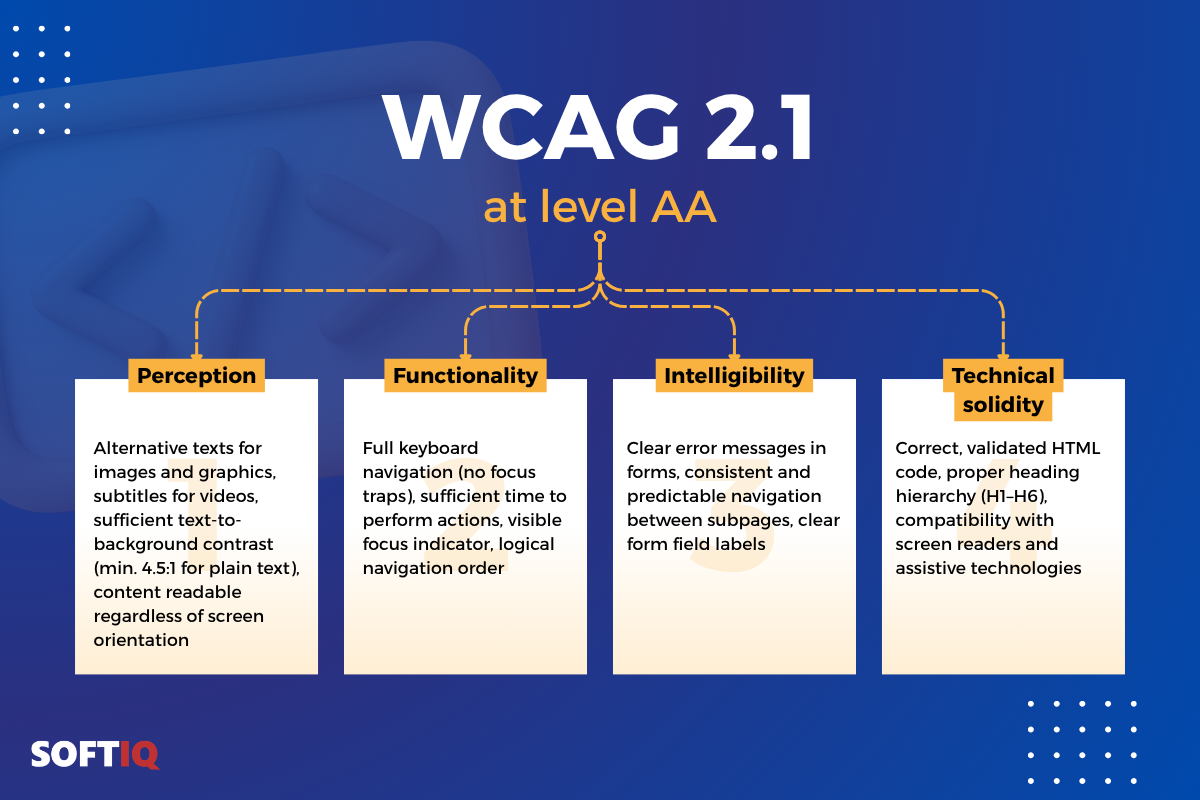
The formal reference point is WCAG 2.1 at level AA – 50 criteria out of 78 available in this version of the standard, divided into four areas:
| POUR Principle | What does this mean in practice for a company website? |
|---|---|
| Perception | Alternative texts for images and graphics, subtitles for video materials, sufficient text-to-background contrast (min. 4.5:1 for plain text), content readable regardless of screen orientation |
| Functionality | Full keyboard operation (no focus traps), sufficient time to perform an action, visible focus indicator, logical navigation order |
| Intelligibility | Clear error messages in forms, consistent and predictable navigation between subpages, clear form field labels |
| Technical solidity | Correct, validated HTML, correct heading hierarchy (H1–H6), compatibility with screen readers and assistive technologies |
It is worth adding some context: in October 2023, W3C released WCAG 2.2, which adds 9 new criteria – including: focus visibility and alternatives to pattern-based authentication. Polish regulations formally still point to 2.1 AA, but 2.2 is already the current technical standard and the direction in which subsequent regulations are going in the world. Since 2.2 is fully backward compatible with 2.1 – meeting 2.2 AA automatically means meeting 2.1 AA – it is simply more profitable for companies planning to audit or rebuild their website in 2026 to immediately aim for the newer standard.
A separate issue is the disclosure obligation: a company selling online must write somewhere on its website how it meets accessibility requirements – a tab, a provision in the regulations, any public document, as long as it is there.
Who monitors compliance with the regulations and what is the procedure?
Supervision is carried out by the President of the Management Board of PFRON and the relevant market surveillance authorities – depending on the industry, it may be the President of UKE, the President of the Office of Rail Transport or the President of the Civil Aviation Office.
Anyone, not just a customer of a given company, can report a violation. The report is forwarded to the President of the State Fund for Rehabilitation of Disabled Persons (PFRON), who either assesses it himself or forwards it to the appropriate industry body. Consumers can also file a complaint directly with the company or go to court.
Before a penalty occurs, the company usually receives a notice to take corrective action. If a product poses a risk to health or safety, a temporary ban on its sale is possible – generally for up to 180 days, with an option to extend it. Only when the company ignores the notices does the case proceed to a formal administrative decision and penalty.
How much can you pay for digital inaccessibility?
This is the question that is asked most often – and here you really need to remember the distinction from the beginning of the article.
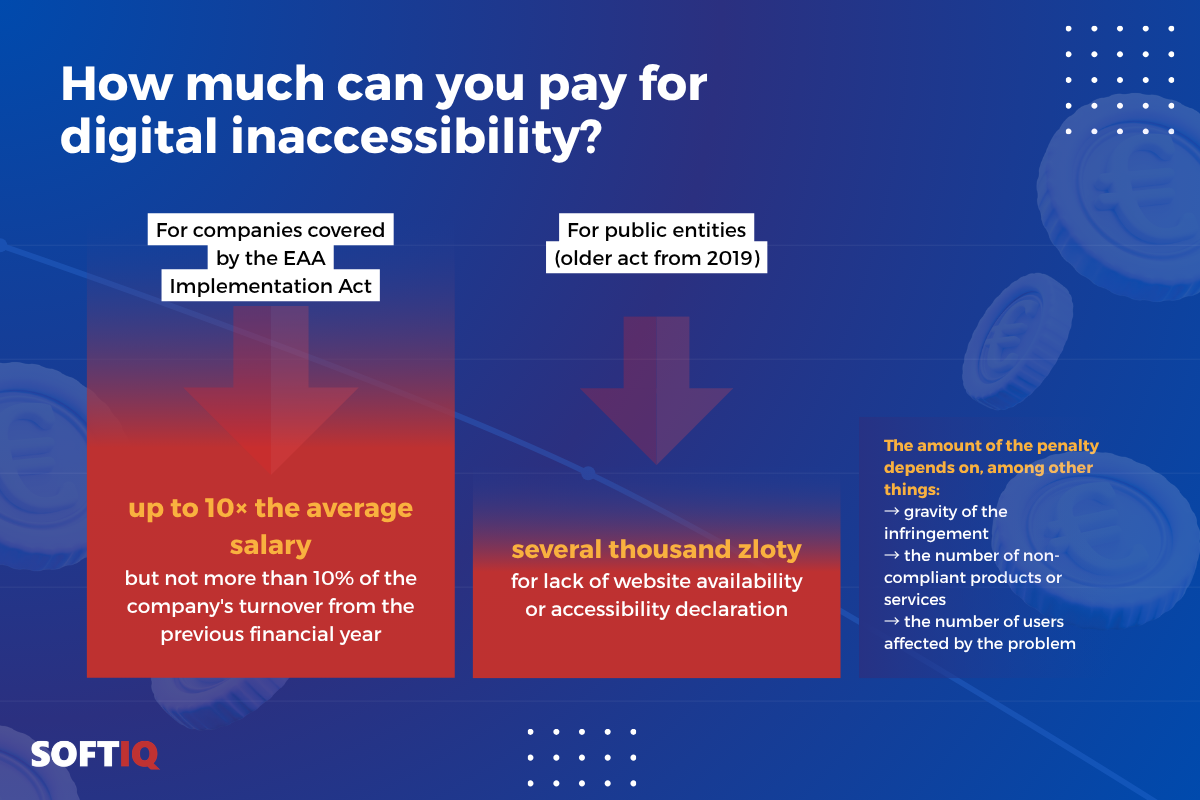
For public entities (older act from 2019), the penalties are administrative and small – about several thousand zlotys for lack of website availability or lack of declaration.
For companies covered by the EAA Implementation Act, things get much more serious. The penalty may amount to ten times the average monthly salary in the national economy for the year preceding its imposition – but not more than 10% of the company’s turnover in the previous financial year. There is no fixed amount here – the authority looks at the gravity of the violation, the number of non-compliant products or services and how many users it affects. The fine must be paid within 14 days of the decision becoming final and the money is transferred to the Accessibility Fund.
And that’s not all, because you have to add indirect costs, which in practice often hurt more than the penalty itself: customers who simply cannot use the inaccessible website, bad reputation if the case comes to light, and the risk of civil claims.
Where to start if you haven’t done anything yet?
First of all, it should be noted that implementing WCAG accessibility is a process, not a one-time correction quickly before an inspection. A reasonable sequence is as follows:
- Accessibility audit – checking the website for WCAG 2.1 AA (and preferably 2.2 AA), automatically and manually – with a screen reader and just a keyboard, without a mouse.
- Priorities – not all mistakes are equally dangerous. Lack of contrast or lack of keyboard support usually blocks the website from being used at all, so you fix that first.
- Team training – accessibility is not a project that is “done and closed”. This is a competence that must remain in the team permanently – especially among frontend, UX and content people, because every new feature or article must also be WCAG compliant.
- Accessibility declaration – clear information for users about the state of the website and where to report a problem.
- Monitoring – any change to the website, a new subpage, a CMS update, or a new component can disrupt previously achieved compliance. Accessibility must be monitored regularly, not just once a year.
Companies that build this competence in-house, instead of outsourcing the audit each time, simply respond faster to changes in regulations and avoid expensive corrections late in the project.
Digital accessibility and frontend training at SOFTIQ Academy also goes in this direction – they teach WCAG-compliant design and coding from the beginning of the process, not as patching at the end.
Frequently asked questions about WCAG and digital accessibility in 2026
The obligation mainly applies to companies offering specific consumer services – e-commerce, banking, telecommunications, transport. Micro-enterprises providing services (less than 10 employees, turnover up to EUR 2 million) are, in principle, exempt, but it is worth checking this individually – the exemption does not cover, for example, micro-enterprises producing goods covered by the Act.
Formally, Polish regulations refer to WCAG 2.1 AA. WCAG 2.2, published by the W3C in October 2023, is the current technical standard and best practice for the future, but it has not yet been explicitly incorporated into Polish law.
For companies covered by the Act implementing the EAA, the fine may amount to up to ten times the average monthly salary, but not more than 10% of the company’s annual turnover. The exact amount is determined by the President of PFRON or the competent market surveillance authority, taking into account the gravity of the violation and the scale of the impact on users.
Everyone. Reports are submitted to the President of the PFRON Management Board, who either evaluates them himself or forwards them to the appropriate market supervision authority.
Not necessarily. Services provided under contracts concluded before this date may operate without changes until June 28, 2030. However, new contracts and new services should meet accessibility requirements out of the box.
Legal status as of August 2026. This article is for informational purposes only and does not constitute legal advice – in specific cases, we recommend consulting a legal advisor specializing in new technologies law or contacting PFRON directly.
Sources: Ministry of Funds and Regional Policy, Biznes.gov.pl, PARP – SME Development Center, text of the Act of 26 April 2024 on ensuring compliance with accessibility requirements for certain products and services by economic entities (Journal of Laws of 2024, item 731), W3C WCAG 2.1 and 2.2 guidelines.